
Cybersecurity and ethical hacking help you protect computers, websites, networks, and personal data from cyberattacks.
Cybersecurity focuses on reducing risk and keeping systems safe. Ethical hacking tests those systems to find weaknesses before criminals can exploit them.
If you own a website, manage a business, or want to learn about online security, understanding both fields helps you make better security choices.
A strong password policy alone is not enough. You also need safe system settings, regular updates, access controls, and a plan for handling security problems.
In this guide, you will learn how cybersecurity and ethical hacking work together, which threats they help address, what tools security professionals use, and how you can start learning ethical hacking safely.
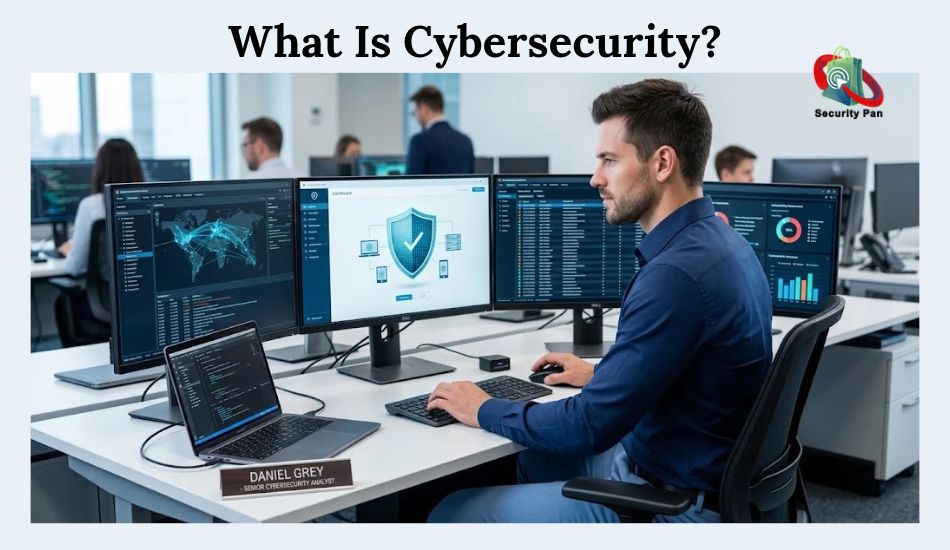
What Is Cybersecurity?
Cybersecurity is the practice of protecting computers, networks, applications, and data from digital threats. It helps stop unauthorized access, reduce data loss, and keep services working.
For example, if you run a WordPress website, cybersecurity includes updating WordPress and its plugins, using multi-factor authentication, limiting administrator access, and keeping secure backups.
Cybersecurity covers several areas:
- Network security: Protects networks and the devices connected to them.
- Application security: Helps prevent flaws in websites, software, and apps.
- Cloud security: Protects cloud accounts, data, and services.
- Identity and access management: Controls who can access systems and what they can do.
- Incident response: Helps teams detect, contain, and recover from security incidents.
These controls work together. If one control fails, other safeguards can help limit the damage.
What Is Ethical Hacking?
Ethical hacking is authorized security testing. A trained professional checks a system for weaknesses and reports them so the owner can fix the risks.
For example, a business may hire an ethical hacker to test its website login system. The tester may look for weak access controls, unsafe settings, or flaws that could expose customer data. The business then uses the findings to improve security.
Ethical hacking must follow clear rules. The tester needs permission from the system owner and must stay within the agreed scope. Testing a website without permission is not made legal simply by calling it ethical hacking.
A responsible test should define:
- Which systems and applications may be tested.
- Which testing methods are allowed.
- When testing can take place.
- How sensitive data must be handled.
- How findings and urgent risks must be reported.
The goal is to improve security, not to damage systems or access data without permission.
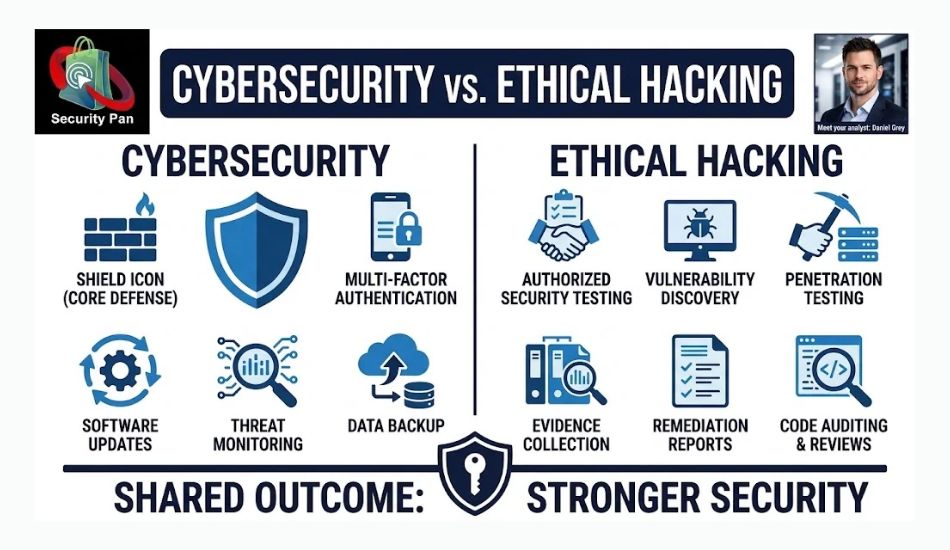
Cybersecurity vs. Ethical Hacking: What Is the Difference?
Cybersecurity and ethical hacking share the same goal: reducing security risk. However, they do different jobs.
| Cybersecurity | Ethical hacking |
| Builds and manages security controls | Tests controls for weaknesses |
| Monitors systems for suspicious activity | Simulates approved attacks |
| Applies patches and access rules | Checks whether defenses work as intended |
| Responds to security incidents | Reports findings and supports remediation |
| Protects systems on an ongoing basis | Tests agreed systems within a defined scope |
Consider a company website. Its cybersecurity team may enable multi-factor authentication, apply software updates, and monitor login activity.
An ethical hacker may then test whether the login system can be bypassed within the approved test scope.
The test results help the company decide what to fix. The security team then makes those changes and checks that they work.
How Ethical Hacking Helps Protect Your Systems
Ethical hacking gives you a way to test security instead of assuming that your defenses are working.
1. Find security weaknesses
A security assessment may uncover outdated software, exposed services, weak access controls, or unsafe application settings. These findings help you understand where attackers may gain an advantage.
2. Test existing defenses
A penetration test can check how selected systems respond to realistic attack methods. The tester works within an agreed scope and records what the test proves.
3. Fix risks in the right order
Not every weakness carries the same risk. Your team should consider how easy a weakness is to exploit, what data or systems are exposed, and what damage could follow.
4. Confirm that fixes work
After a weakness is fixed, retesting helps confirm that the original problem has been addressed. It can also reveal whether the change caused another issue.
Ethical hacking is one part of a wider security program. It does not replace patching, monitoring, secure design, backups, or incident response.
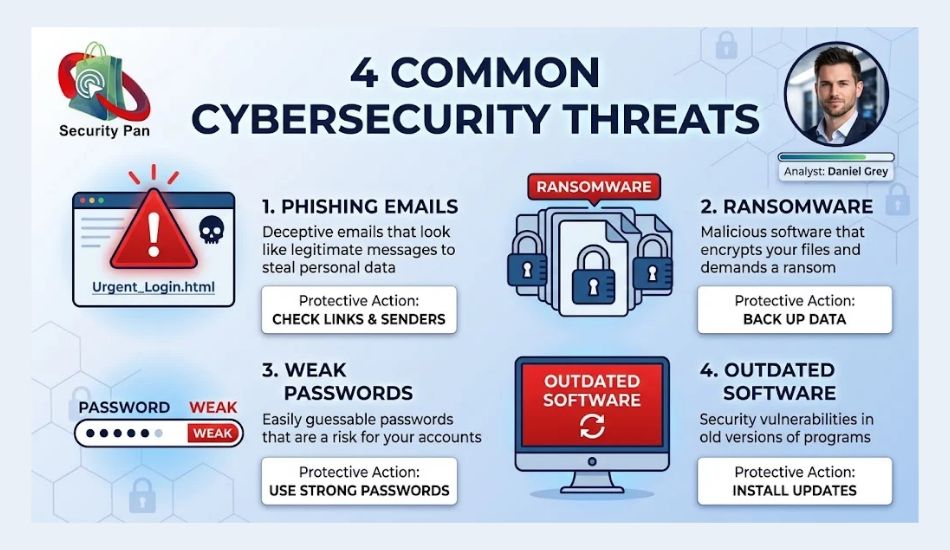
Common Cybersecurity Threats Ethical Hackers Help Detect
1. Phishing and social engineering: Attackers use fake emails, messages, websites, or phone calls to trick people into sharing information or approving unsafe actions. Staff training, strong authentication, and email security controls help reduce this risk.
2. Malware and ransomware: Malicious software can steal data, disrupt systems, or encrypt files. Secure backups, endpoint protection, restricted access, and tested recovery plans can reduce the impact.
3. Weak passwords and access controls: Reused passwords and excessive user permissions can expose accounts and data. Use unique passwords, a password manager, multi-factor authentication, and least-privilege access.
4. Outdated software and misconfigurations: Unpatched applications and unsafe settings can leave systems open to known attacks. Keep software updated and review important settings on a regular schedule.
5. Ethical hackers can test selected technical weaknesses: They do not automatically prevent every phishing attack, malware infection, or data breach. Each risk needs suitable controls and ongoing review.

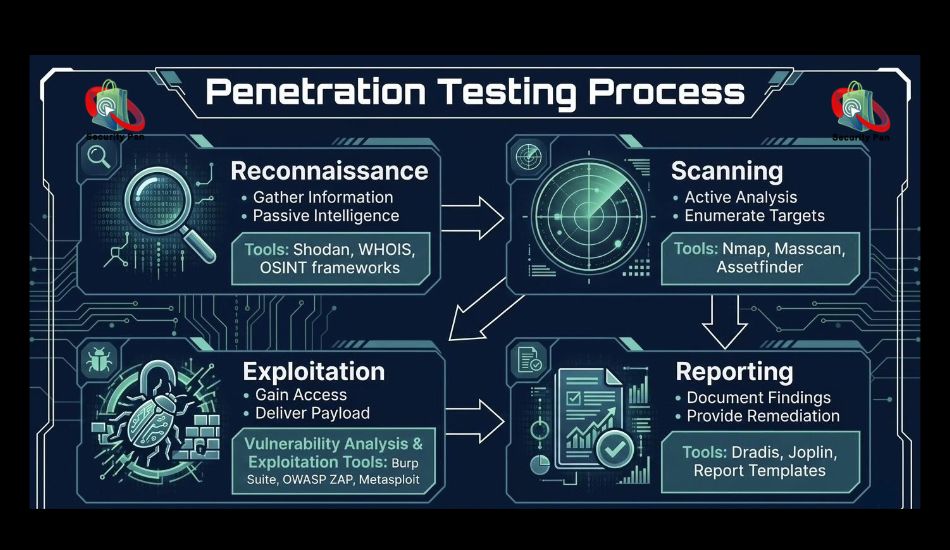
Common Ethical Hacking Tools and Their Uses
Security professionals choose tools based on the system, the test goal, and the permission they have received.
| Tool or tool category | Main purpose |
| Kali Linux | A Linux distribution that bundles many security tools. |
| Nmap | Discovers hosts, open ports, and network services |
| Wireshark | Inspects network traffic for troubleshooting and analysis |
| OWASP ZAP | Helps test web applications for security issues |
| Burp Suite | Supports web application security testing |
| Vulnerability scanners | Check systems for known weaknesses |
| SIEM platforms | Collect and analyze security events for detection and response |
Tools do not replace expert judgment. A scan can produce false positives, miss certain weaknesses, or fail to explain the real business risk.
You need to review the results, verify findings safely, and document what needs to change.
Only test systems you own or have explicit permission to assess. Use a lab or other approved environment when learning new tools.
How to Practice Ethical Hacking Legally
If you want to learn ethical hacking, start with the basics and practice in a controlled environment.
- Learn networking, operating systems, web basics, and common security concepts.
- Study common vulnerabilities and how defenders prevent them.
- Use purpose-built training labs or systems you own.
- Read established testing guidance, such as the OWASP Web Security Testing Guide.
- Document each finding, its impact, and a safe way to fix it.
- Before testing any real system, obtain permission and agree on the scope.
Do not scan, exploit, or attempt to access a public website or another person’s device just because it is reachable. Public access does not mean you have permission to test it.
How to Improve Your Cybersecurity Today
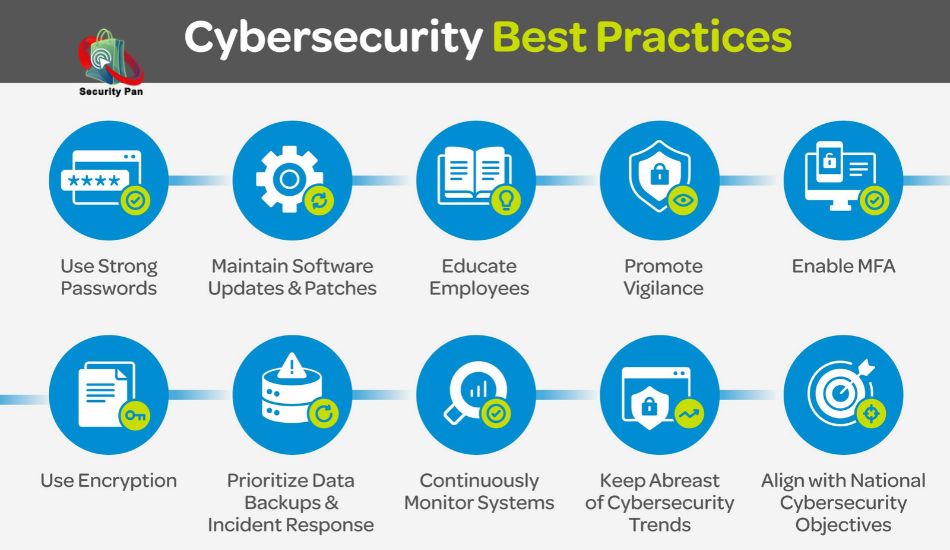
You can reduce many common risks by taking a few practical steps:
- Enable multi-factor authentication on important accounts.
- Use unique passwords and store them in a trusted password manager.
- Install security updates for your operating system, apps, website software, and plugins.
- Back up important data and test that you can restore it.
- Remove accounts that are no longer needed.
- Give each user only the access required for their role.
- Review account alerts and investigate unexpected login activity.
- Create a plan for reporting and responding to a security incident.
If you manage a business, use a risk-based approach. Identify your most important data and services first, then choose controls that match the risks you face.
The NIST Cybersecurity Framework can help organizations organize their work around governance, identifying risk, protection, detection, response, and recovery.

How Beginners Can Start Learning Ethical Hacking
You do not need to start by running advanced tools. Build a strong base first.
- Step 1: Learn networking. Understand IP addresses, ports, DNS, HTTP, and how devices communicate.
- Step 2: Learn operating systems. Practice basic Linux and Windows administration, user permissions, logs, and file management.
- Step 3: Study web security. Learn how authentication, sessions, input validation, and access controls work.
- Step 4: Practice in legal labs. Use training environments designed for security testing. Keep notes on what you tested and what you learned.
- Step 5: Learn to report findings. A useful report explains the weakness, its possible impact, evidence from the approved test, and steps to fix it.
- Step 6: Keep learning. Follow trusted security guidance and review new findings relevant to the systems you work with.

Conclusion: Build Better Security Through Testing and Prevention
Cybersecurity and ethical hacking work best together. Cybersecurity helps you build and maintain defenses. Ethical hacking checks whether selected defenses have weaknesses that need attention.
If you manage a website or business, start with strong authentication, timely updates, secure backups, and careful access control. Use authorized security testing to find and fix weaknesses that routine checks may miss.
If you are learning ethical hacking, build your skills step by step and practice only in approved environments. Security improves when you test carefully, report clearly, and fix the problems you find.
Informative article: How Cybersecurity Fencing Protects Your Home from the Latest Cyber Threats?
1. Is cybersecurity the same as ethical hacking?
No. Cybersecurity covers the wider work of protecting systems and data. Ethical hacking is one testing method used to find and report security weaknesses.
2. Is ethical hacking legal?
It can be legal when the tester has proper authorization and follows the agreed scope and applicable laws. Testing without permission can create legal and security risks.
3. Which tools do ethical hackers use?
Tools vary by task. Common examples include Nmap for network discovery, Wireshark for traffic analysis, and OWASP ZAP or Burp Suite for web application testing.
4. Can ethical hacking prevent every cyberattack?
No. A test covers specific systems and methods at a particular time. New weaknesses can appear later, so security controls, monitoring, updates, and incident response remain important.
5. Can beginners learn ethical hacking?
Yes. Start with networking, operating systems, and web security. Practice in legal training labs before moving to authorized real-world assessments.
6. How often should a business test its security?
The schedule depends on the business’s risk, systems, and legal or contractual needs. Test after major changes and when new risks justify it. Combine testing with regular vulnerability management and ongoing monitoring.

